Putting Wings on SPHINCS

May 1, 2018·
Stefan Kölbl
Stefan Kölbl
· 0 min read
Abstract
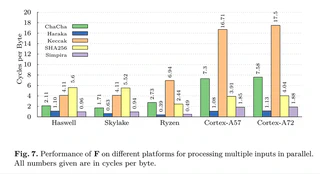
SPHINCS is a recently proposed stateless hash-based signature scheme and promising candidate for a post-quantum secure digital signature scheme. In this work we provide a comparison of the performance when instantiating SPHINCS with different cryptographic hash functions on both recent Intel and AMD platforms found in personal computers and the ARMv8-A platform which is prevalent in mobile phones. In particular, we provide a broad comparison of the performance of cryptographic hash functions utilizing the cryptographic extensions and vector instruction set extensions available on modern microprocessors. This comes with several new implementations optimized towards the specific use case of hash-based signature schemes. Further, we instantiate SPHINCS with these primitives and provide benchmarks for the costs of generating keys, signing messages and verifying signatures with SPHINCS on Intel Haswell, Intel Skylake, AMD Ryzen, ARM Cortex A57 and Cortex A72.
Type
Publication
publications
Stefan Kölbl
Authors
Staff Engineer, Tech Lead Manager

I am a Staff Engineer and Tech Lead Manager at Google, where I work in the Security Engineering team. My focus is on post-quantum cryptography and enabling developers at Google and across the internet to use cryptography safely and correctly.

I have a PhD in cryptography and an extensive background in the design and analysis of symmetric-key algorithms, post-quantum cryptography, and lightweight cryptography. I have contributed to several cryptographic standardization efforts, including the SKINNY cipher, which is part of the ISO/IEC 29192-2 standard. I also contributed to the SPHINCS+ signature scheme, which was standardized by NIST as FIPS 205. I currently represent Switzerland in the ISO/IEC JTC 1/SC 27/WG 2 committee for cryptography and security mechanisms.

Before joining Google, I was a Senior Technology Manager at Cybercrypt and a postdoctoral researcher at the Technical University of Denmark, working on the H2020 PQCRYPTO project.