Mind the Gap - A Closer Look at the Security of Block Ciphers against Differential Cryptanalysis

Aug 2, 2018·
Ralph Ankele
Stefan Kölbl
Stefan Kölbl
· 0 min read
Abstract
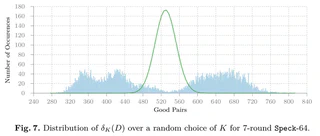
Resistance against differential cryptanalysis is an important design criteria for any modern block cipher and most designs rely on finding some upper bound on probability of single differential characteristics. However, already at EUROCRYPT'91, Lai et al. comprehended that differential cryptanalysis rather uses differentials instead of single characteristics. In this paper, we consider exactly the gap between these two approaches and investigate this gap in the context of recent lightweight cryptographic primitives. This shows that for many recent designs like Midori, Skinny or Sparx one has to be careful as bounds from counting the number of active S-boxes only give an inaccurate evaluation of the best differential distinguishers. For several designs we found new differential distinguishers and show how this gap evolves. We found an 8-round differential distinguisher for Skinny-64 with a probability of $2^−56.93$ , while the best single characteristic only suggests a probability of $2^−72$. Our approach is integrated into publicly available tools and can easily be used when developing new cryptographic primitives. Moreover, as differential cryptanalysis is critically dependent on the distribution over the keys for the probability of differentials, we provide experiments for some of these new differentials found, in order to confirm that our estimates for the probability are correct. While for Skinny-64 the distribution over the keys follows a Poisson distribution, as one would expect, we noticed that Speck-64 follows a bimodal distribution, and the distribution of Midori-64 suggests a large class of weak keys.
Type
Publication
publications
Stefan Kölbl
Authors
Staff Engineer, Tech Lead Manager

I am a Staff Engineer and Tech Lead Manager at Google, where I work in the Security Engineering team. My focus is on post-quantum cryptography and enabling developers at Google and across the internet to use cryptography safely and correctly.

I have a PhD in cryptography and an extensive background in the design and analysis of symmetric-key algorithms, post-quantum cryptography, and lightweight cryptography. I have contributed to several cryptographic standardization efforts, including the SKINNY cipher, which is part of the ISO/IEC 29192-2 standard. I also contributed to the SPHINCS+ signature scheme, which was standardized by NIST as FIPS 205. I currently represent Switzerland in the ISO/IEC JTC 1/SC 27/WG 2 committee for cryptography and security mechanisms.

Before joining Google, I was a Senior Technology Manager at Cybercrypt and a postdoctoral researcher at the Technical University of Denmark, working on the H2020 PQCRYPTO project.